部
Components

桜 means 'cherry tree'

Animation / stroke order not available.
LOG IN to view this kanji's mnemonic
Strokes : 10    Frequency: 1329   JLPT: N1    Usefulness: 5    Study set: 5-18    Grade: 5   Intermediate lesson: -    Beginner lesson: -   Begins 43 words   Used in 101 words   Used in 1248 names   Not used as a component
Jōyō (常用)
On
   オウ
Kun
   さくら cherry tree
On    ヨウ
Name    さ   ろう
櫻   樱 (Chinese)  
A Joy o' Kanji essay is available for 桜 - click the badge to download
Discover what cherry blossoms have meant to the Japanese. See how the blossoms connect to war, learning what "You and I are cherry blossoms that bloomed in the same year" means. Find out ways of consuming the blossoms for real or euphemistically. And learn to say, "The cherry blossoms fluttered down whenever the wind blew" and "The cherry blossoms were at their best."
The essay is also included in the following Thematic Bundles
45
Emblematic Trees
桜 松 杉 柳
These essays showcase four types of trees that afford great pleasure. The Japanese love seeing rows of them along rivers, the seashore, and avenues (especially on the world's longest tree-lined road), and people famously picnic under cherry blossoms. To the Japanese, the pine, cedar, willow, and cherry also symbolize key qualities: transience and mortality (the cherry); longevity, vitality, and sincerity (the cedar); emotional flexibility, weakness, sadness, and thinness (the willow); and superior rankings (the pine). Moreover, these trees play key roles in the arts, such as haiku, woodblock prints, ink paintings, lyrics, Noh theater, and ghost stories.
77
Heian-Era Literary Firsts
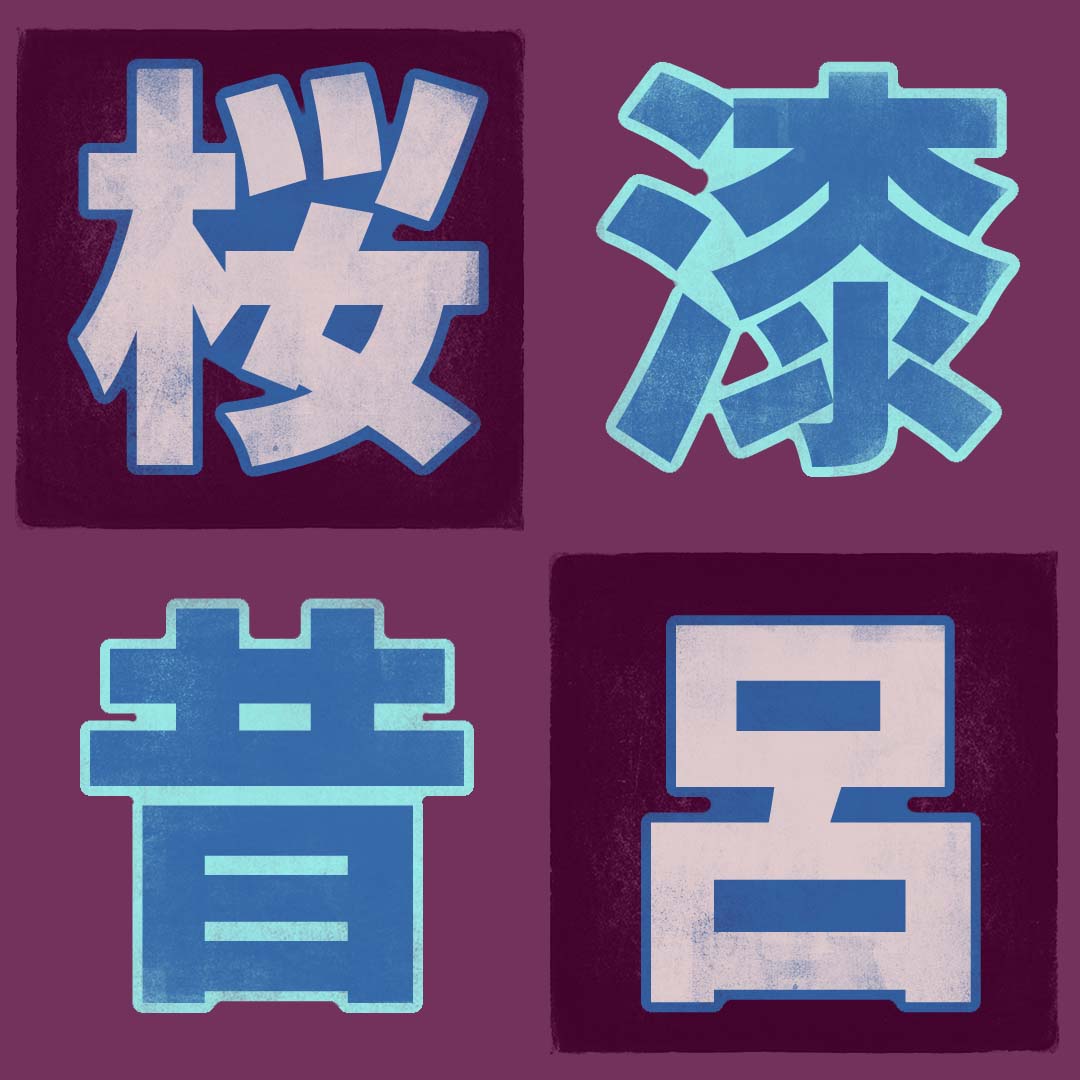
桜 漆 昔 呂
The Heian period (794–1185) produced literary firsts, as this bundle shows. Major publications included "The Tale of Genji," (54 volumes!), "The Tales of Ise" (collected poems and prose), "The Tale of the Heike" (an epic), and "Konjaku Monogatarishu" (more than a thousand tales from India, China, and Japan, including Japanese folklore). The famous いろは poem emerged, using all basic archaic syllables only once. And whereas people used to wax poetic about ume (Japanese apricots), Heian poetry instead reflected a sudden appreciation of cherry blossoms, with 花 (flower) newly meaning "cherry blossom" in verse.
113
Meiji Era: Fusion Food
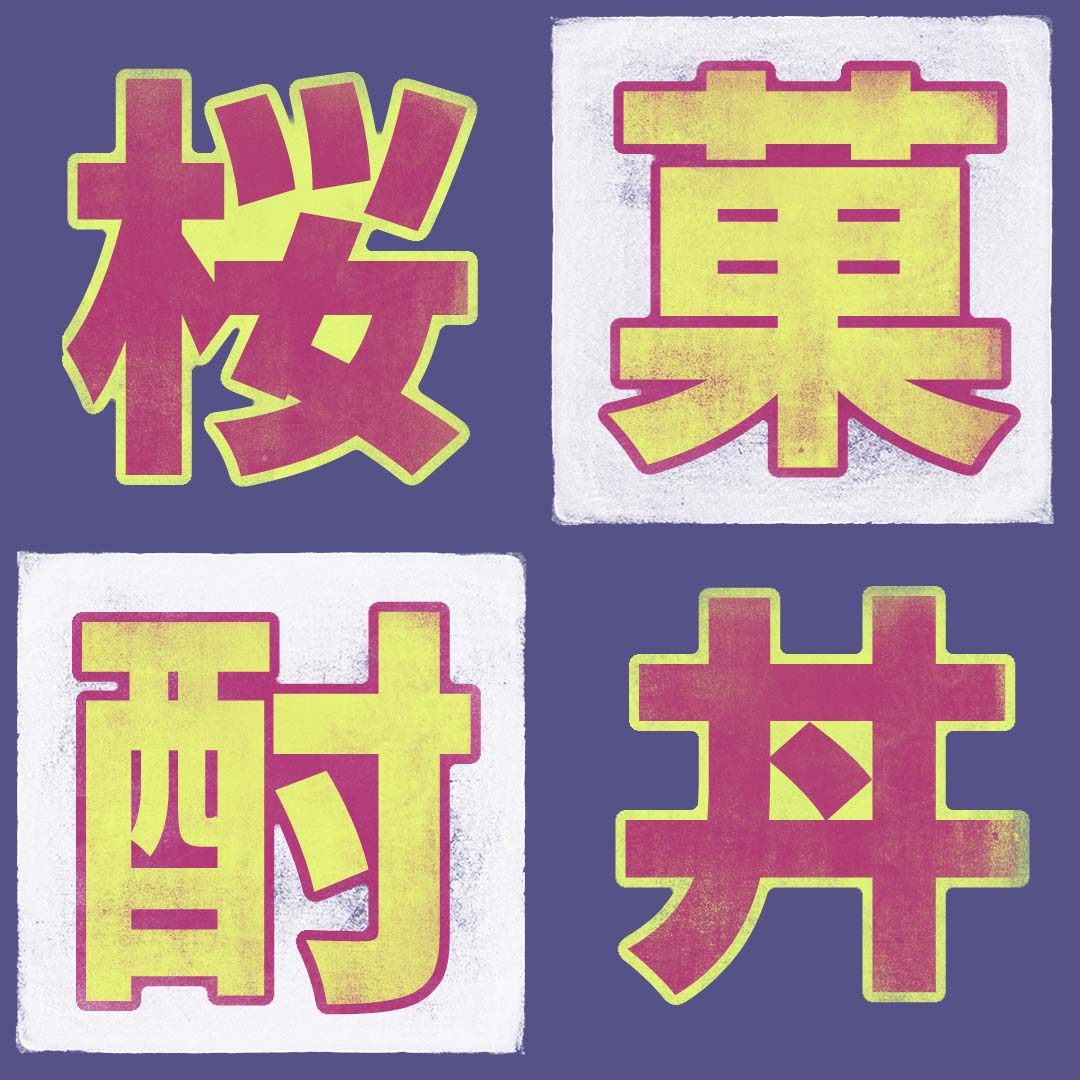
桜 菓 酎 丼
Westernizing in the Meiji era (1868–1912) changed the way the Japanese drank and ate, as this bundle reflects. Importing British machinery enabled people to mass-produce shochu. Western confections flowed into Japan, and the arrival of ice cream inspired a green tea flavor. Before 1868, the Japanese didn't eat beef, believing cows to be exclusively for physical labor. Buddhism also drove a disdain for consuming quadrupeds. But with westernization the Japanese suddenly viewed beef consumption as enlightened. Out of discomfort, though, they did name some meat dishes with flowery euphemisms (e.g., peonies and cherry blossoms).
⿰  木 tree  ⿱  ⺍ (小) small  女 woman; female  
Explore these components visually on The Kanji Map ⇗
LOG IN to view kanji mastery data
LOG IN to view your flashcards
In the most useful 10,000 words in Japanese, 桜 is used 3 times, read 2 ways.
Across all words in Japanese, 桜 is used 77 times, read 2 ways (with 1 variation).
Showing:
オウ : 8 words FIND ALL
お う か 1
noun
cherry blossom
(click the word to view an additional 1 reading, examples and links)
さくら : 30 words FIND ALL
さ く ら 0
noun
1. cherry tree; cherry blossom
2. decoy; fake buyer; shill  (also 偽客)
(click the word to view an additional 2 meanings and 3 forms, examples and links)
さくら (read as ざくら) : 39 words FIND ALL
は ざ く ら 2
noun
cherry tree in leaf; cherry tree whose blossoms have fallen, revealing the young leaves
(click the word for examples and links)
An additional 8 less common words include 桜 but the readings have not yet been categorized.
Henshall: 653 (originally: 1036)  Joy o' Kanji : 1036  Key to Kanji: 62 

Cascading kanji view

桜
オウ   さくら cherry tree   
Please LOG IN to view this kanji's mnemonic
⺍
small
女
ジョ   ニョ   ニョウ   woman; female   おんな woman   め woman   
木
モク   ボク   き    こ- tree   
Please LOG IN to view this kanji's mnemonic
大
ダイ   タイ   おおきい big   おおいに very much   おお-    
Please LOG IN to view this kanji's mnemonic
一
イチ   イツ   ひとつ    ひと- one   
人
ジン   ニン   ひと person   
丨
stick   
Problem with this kanji? Question or comment? Please CONTACT US.

Kanshudo is your AI Japanese tutor, and your constant companion on the road to mastery of the Japanese language. To get started learning Japanese, just follow the study recommendations on your Dashboard. You can use Quick search (accessible using the icon at the top of every page) to look up any Japanese word, kanji or grammar point, as well as to find anything on Kanshudo quickly. For an overview, take the tour.
Search results include information from a variety of sources, including Kanshudo (kanji mnemonics, kanji readings, kanji components, vocab and name frequency data, grammar points, examples), JMdict (vocabulary), Tatoeba (examples), Enamdict (names), KanjiVG (kanji animations and stroke order), and Joy o' Kanji (kanji and radical synopses). Translations provided by Google's Neural Machine Translation engine. For more information see credits.
×